Summary
This proposal introduces a monetary mechanism that prevents the network difficulty from dropping below a minimum security threshold.
When the network difficulty drops below the critical threshold due to a market price fluctuation, the protocol activates an additional block reward that incentivises miners to return to the network. The reward level grows until the network reaches the required difficulty threshold.
As the total transaction fee increases, the emergency reward decays.
When the network difficulty returns above the threshold, the protocol burns a portion of transaction fees to restore the total coin supply to its expected maximum.
Concept
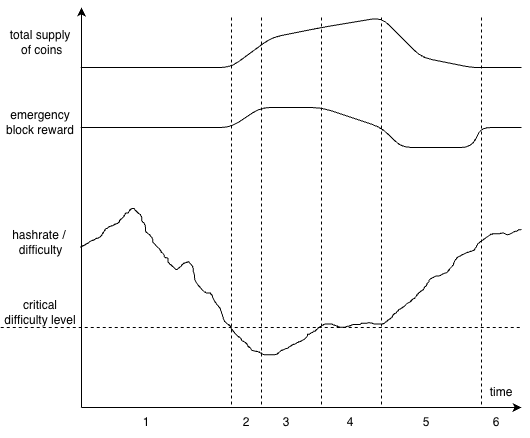
Diagram:
-
Network operates normally. The total supply of coins is constant. Miners are rewarded through transaction fees. miners_compensation = market_coin_price * transaction_fee is sufficient to keep the hashrate above the critical difficulty level.
-
Network difficulty drops below a critical security level. The protocol activates emergency tail emission. The protocol gradually increases the emergency block reward until the difficulty stops dropping. Due to emissions, the total supply starts growing beyond the maximum limit.
-
Once the difficulty level starts increasing, the protocol gradually decreases the block reward level.
-
Protocol ensures that emergency_reward + total_transaction_fee is sufficient to keep a minimal difficulty level. If total_transaction_fee grows, the emergency_reward decays.
-
total_transaction_fee is sufficient to keep the minimal hashrate difficulty. Emergency emission is disabled. A percentage of the transaction fee is burned to reduce the total coin supply.
-
The total supply of coins is returned to the maximum limit. Transaction fees are no longer burned.
The emergency emission kicks in only at critical conditions as a safety mechanism.
The compensation level is based on the network’s difficulty and responds to the miner’s behaviour. Protocol does not need to know the exact coin prices.
Emergency inflation is a burden that is shared with all participants until the max supply is restored.
The community is in control and can prevent the emergency emission from happening by:
Sending transactions with a bigger fee to incentivise miners to come back.
Run unprofitable miners to keep the minimal hashrate levels.
The emergency threshold can be hardcoded as a fixed protocol parameter or as a function of the previous difficulty levels.
Future improvements
A max network difficulty threshold can be introduced to activate transaction fee burn. If the mining reward increases due to high market prices and the network difficulty exceeds the max_threshold, a percentage of the transaction fee is burned. This allows the system to accumulate a “reserve” that can be used in the next emergency mission phases. Also, this would cap the network’s energy consumption.
Alternatives
A1. Transaction fee limit.
Instead of introducing block rewards and emissions, the protocol will increase base transaction fees.
Cons: The approach does not guarantee that participants will send the required number of transactions and pay the required fees, rather than waiting.
A2. Failsafe fund.
The community can create a failsafe fund via a smart contract. A smart contract can operate on the L2 level outside of the L1 protocol. The smart contract can start sending transactions to itself with increased transaction fee. The community would have to donate to the failsafe fund and keep it positive. Such a failsafe fund can be organised as a community fund without the use of smart contracts.
Cons: there may not be enough active mecenatas that are willing to donate the required amount.
A3. Adaptive block sizes.
Protocol may introduce a dynamic block size and reduce network throughput to incentivise higher transaction fees. See @Bit_Cat 's proposal: Adaptive block sizes
Cons: The approach does not guarantee that participants will provide the required amount promptly via transaction fees.
A4. Demurrage
Introduce a stationary UTXO fee that will increase the number of transactions.
Can be implemented as an additional approach that can reduce the total coin supply and return it to the expected maximum.
Pros: reduce storage requirements by annihilation of dead accounts.
Cons: introduces complexity for wallet owners, adds additional transactional load to the system